WhatsApp audio
How to save WhatsApp audio for transcription
Save the original message on Android, iPhone, Web, or desktop, verify the copy, and upload OGG or M4A for transcription.
Updated September 3, 2026
To transcribe a WhatsApp voice message outside the app, first save or share a copy of the original message, play the copy to the end, and then upload it. Depending on the device and app version, the file may appear as OGG, OPUS, or another format. Transcrever accepts .ogg; a standalone .opus file must be genuinely converted to a supported format. Renaming the extension does not convert the audio.
Use this workflow when you need to search a long voice message, copy an instruction, verify names and numbers, keep a note outside the conversation, or export the result as TXT, DOCX, SRT, or VTT.
Quick answer: preserve the original message, avoid rerecording it through a loudspeaker, identify the real format, and test the saved copy before upload. For sensitive content, decide whether it should leave the device and who may access the exported text.

Decide whether to use WhatsApp's built-in transcript or export audio
A transcript shown inside WhatsApp may be enough to read one short message. Exporting the file is more useful when you need to:
- edit or correct the text;
- keep individual message files with clear names;
- keep a separate TXT or DOCX record;
- create timed SRT or VTT;
- compare the words with the source audio;
- use the result in notes, support records, or research.
App features and menu names can vary by operating system, account, region, and version. Start by checking the options available on your own device.
Save the original voice message
Use Share, Save, Download, or the equivalent option provided by the app and operating system. The destination may be Files, Downloads, cloud storage, email, or another application.
After saving:
- locate the new file;
- check its full name and extension;
- play the start and end;
- compare the duration with the message in WhatsApp;
- keep the in-app original until the transcript is complete.
The exact command name is not the success criterion. A successful handoff creates a local file that opens, has sound at the beginning and end, and has a duration that matches the message in the conversation. If Share produced only a shortcut, return to WhatsApp and choose a destination that stores a real copy.
Do not use screen recording or place another phone beside the speaker unless there is no other route. Rerecording adds room noise, echo, notifications, and volume changes.
Understand OGG, OPUS, and file extensions
OGG is a container, while Opus is an audio codec. A WhatsApp voice message may use Opus audio inside an OGG container. Different file managers and sharing paths may display .ogg, .opus, or another extension.
The extension is only a label. Changing message.opus to message.ogg does not rewrite the contents. A real conversion must decode the source and encode or package it in a supported destination format.
Upload an OGG WhatsApp message
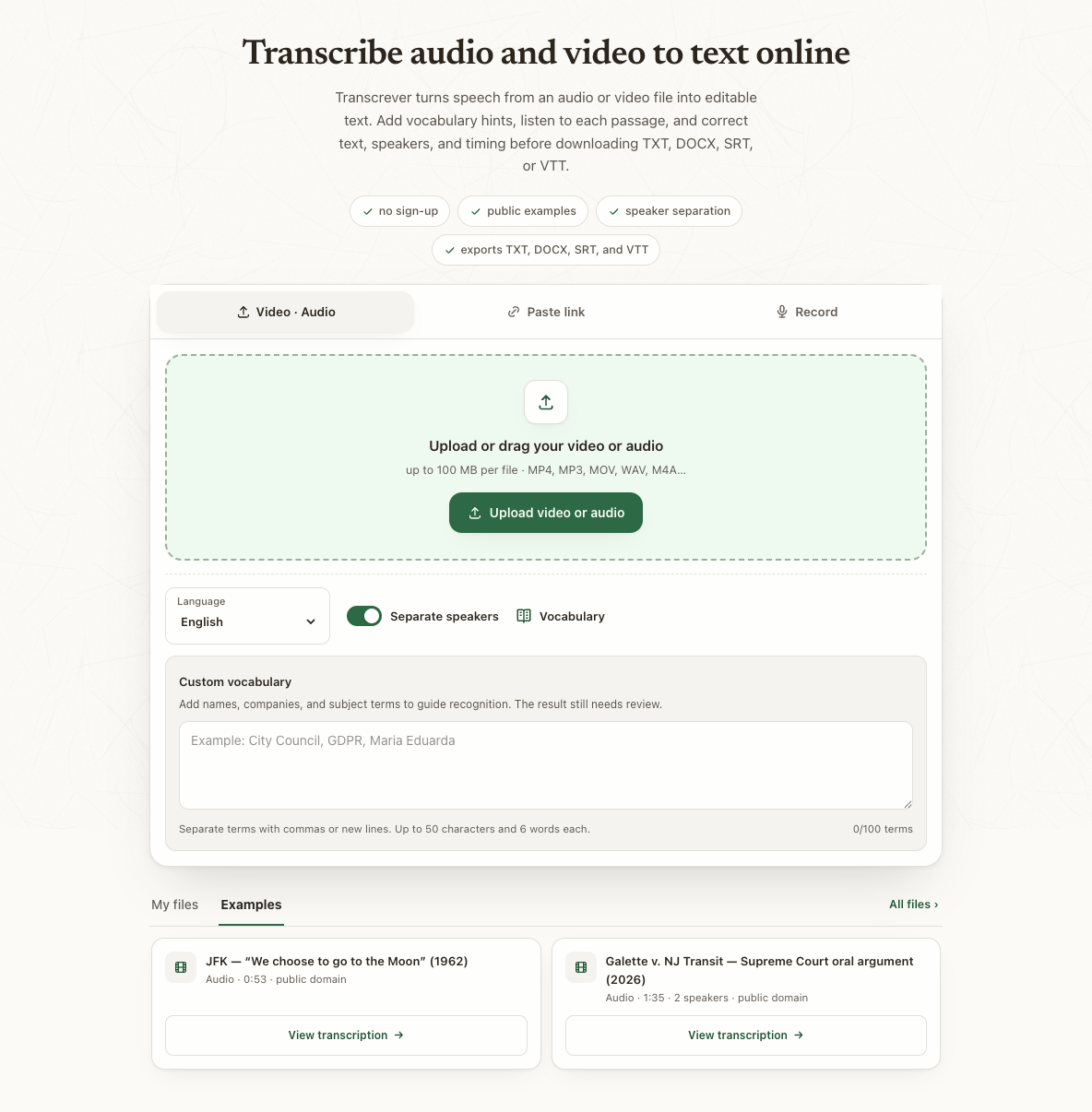
- Open WhatsApp audio transcription.
- Select the saved
.oggfile. - Choose the language spoken in the message.
- Start transcription and wait for the complete result.
- Play uncertain passages while correcting names, numbers, addresses, and instructions.
- Export TXT for plain text or DOCX to keep working in a document editor. Use SRT or VTT when timing must be preserved.
If the saved file is .m4a, you can also open M4A to text and upload it without renaming the extension.
If the file appears in the picker but cannot be processed, confirm that it plays locally and was not saved as an empty shortcut or incomplete download.
Convert OPUS only when necessary
Use conversion when the saved file ends in .opus and the upload does not accept it, or when your local player cannot open it reliably.
Choose a trusted local media application when the message is sensitive. If you use an online converter, read its retention and privacy terms before uploading. Keep the original, convert one copy, and play the converted beginning and end before transcription.
Converting to MP3 may improve compatibility, but it does not improve speech that is already clipped, noisy, or inaudible. Avoid repeated conversions.
Review the transcript by message type
The highest-risk details depend on the message:
- address or appointment: street, number, date, time, and contact name;
- work instruction: action, owner, quantity, deadline, and exception;
- customer support: product, order number, reported problem, and promised action;
- interview or research: participant, quotation, consent boundaries, and context;
- personal message: names, health or financial details, and who may receive the export.
When two people speak in a forwarded recording or background speech overlaps the main voice, replay the boundary before assigning words to anyone.
Troubleshoot common problems
| Symptom | What it usually means | What to do |
|---|---|---|
| file has no visible extension | the file manager hides it | inspect file information or open it in a media app |
.opus is rejected | format is not accepted directly | convert a copy to a supported format |
| renamed file still fails | only the filename changed | perform a real conversion |
| saved copy is shorter | export or download was incomplete | save it again and compare durations |
| transcript has missing words | source audio is weak, noisy, or overlapped | replay and mark uncertainty instead of guessing |
| names and numbers are wrong | uncommon terms or brief syllables were misheard | check each important occurrence against the audio |
Privacy checklist
Before moving a voice message outside WhatsApp, ask:
- Does the recording contain personal, health, financial, work, or client information?
- Do you have a legitimate reason to process and store it?
- Should a cloud converter receive the file?
- Where will the transcript be saved and who can open it?
- When can the exported copies be deleted?
The fact that a file can be shared does not mean every destination is appropriate.
Frequently asked questions
Can I transcribe a WhatsApp voice message without playing it aloud?
Yes. Save or share the original file and upload that copy. This normally preserves more useful audio than recording the loudspeaker with another device.
Are OGG and OPUS the same thing?
No. OGG is a container and Opus is a codec, although they often appear together in WhatsApp audio. The displayed extension depends on how the file was saved.
Can I convert OPUS by changing the extension?
No. Renaming changes only the label. A valid conversion must read the original audio and write a supported output.
Which format should I export?
Choose TXT for plain text or DOCX to keep working in a document editor. Choose SRT or VTT when the transcript must retain time ranges for playback or subtitles.
Next step
Save the original message, verify that the copy plays completely, then open WhatsApp audio transcription. Review the details that would cause a real problem if copied incorrectly before exporting the result.